Category Archives: Life in the Yucatan

The good, the bad and the ugly. Telling it like I see it for over 10 years now.

Elio al Mare, Progreso, Yucatan

Better late than never, is the Critics motto when it comes to trying out restaurants that have already been commented on by others; take the Wayan’e case for example, where the Critic waited 20 years to try the famous tortas and tacos and lo and behold, when he did get around to trying them, he was convinced that the mythical reputation was justified.

Elio al Mare, located between Progreso and Chicxulub right on the beach, has not been around for 20 years, but it has been commented on and recommended by Italian friends in Merida (OK one Italian friend) and several other people as well. In fact, it has become such common knowledge that an article even appeared on the restaurant in Plan B, the Diario de Yucatans colorful Thursday supplement featuring fun, exciting activities and places to go as well as the latest photos of Meridas beautiful people having a great time at Fridays.

So the Critic, with the Motley Crew, an assortment of friends who occasionally dine and travel together and is made up of several entrepeneurs, including the Better Half, a doctor and his wife and an engineer set out for Progreso. Why the Critic is even mentioning the existence let alone the composition of the group is not entirely clear, as it has absolutely nothing to do with the comment at hand, which is Elio al Mare.

Elio al Mare is in a converted house, right on the beach and open to the breeze that on this occasion was just perfect. Sometimes that breeze is too strong and no amount of gel will keep your do in place and you end up looking like Mickey Rourke in any of his latest films with your hair standing on end. At other times the breeze at the beach is too weak, thereby allowing the mosquitoes to get a wing-hold in the sticky humid night air, and your legs will become an “All You Can Suck!!!” bloody nightmare. As mentioned before, the breeze was perfect.

The man in charge, an Italian one assumes, as were several key people in bar and kitchen areas, greeted the party and threw together two tables on the deck/porch and the Crew was seated comfortably. A menu was presented and then everyone was served a sangria, cortesia of the restaurant, from a large punch bowl in the middle of the restaurant. A refreshingly original way to start a great meal!

So how was the food you may be wondering?

From the bread (warmed) and mushroom dip, through the octopus carpaccio, which was more like a cross between carpaccio and ceviche served with parmigiano chunks, onion and tomato, through the main courses, all pastas, were incredible. The other appetizers, an ensalada Caprese and a Greek salad, were delicious.

The Critic ordered a Carbonara, which in Merida usually means loads and loads of cream and a hint of bacon; all that cream has nothing to do with a Carbonara pasta; and this time, it was perfect. Not good, perfect. The pasta itself, homemade and cooked to al dente perfection. The egg and olive oil in the pasta, perfect. And the crunchy bacon chunks were not hiding timidly under bits of parsley, but out there in full force and in your face. The seafood pasta ordered by the doctors wife was a-ma-zing. The doctor, the Crews most finicky eater and skeptical sampler of menus, was motivated to enthusiastically exclaim that his lasagna was excellent, a comment that rarely escapes his lips with such feeling.

It might be because the Critic was hungry, that all this seemed so wonderfully delicious; however, avid readers may have deduced by the previous review that the Critic had in fact lunched rather heavily two hours earlier on Progresos malecon, so the rave review is not a result of an empty stomach.

The one quibble was with a glass of red wine ordered by yours truly, which was chilled to room temperature in Inuvik, but that was it.

The service was fine and the bill for 6, with only a little alcohol served, came to about 1800 pesos before tips.

Elio al Mare is one of the best restaurants the Critic has had the pleasure of reviewing in a while. Open from 1 – 10, they don’t take credit cards, only cash and will modify their operating hours during the summer months, opening a little later, from 3 – 12.

To make this review a classic Casual Restaurant Critic review, there is no address. The fine folks at Yucatan Today have one though, click here and you shall find it!

Happy eating!

Merida Malls – A Primer

For those of you into malls, you will happy to know that there is a glut (too many, pues) of shopping malls in the formerly-white city of Merida. Wherever you turn, there is another mall! This is in addition to the already gazillion little placitas that people keep building on any available corner that feature independent and sometimes chain business that quite often are doomed to fail as a result of over-supply. This is the mall panorama at the time of this writing:

  • Plaza Dorada – The ‘family’ mall as they like to advertise themselves. This mall was one of the first malls on this side of the city and is an early architectural design by the now famous Augusto Quijano. It looks severely dated now, however, and is comprised of a series of independently owned shops for the most part along with one or two chains including a supermarket. The feel is cheap, and their market could be described as lower middle class. Not a place you would want to spend any more time than necessary in. The arrangement in the mall is that all commercial space is privately owned, so any renovations or improvements have to be agreed upon my all the owners, which, in Merida, is a challenging prospect to be sure.

    In addition, Plaza Dorada was eclipsed by the construction of the Las Americas mall right next door, which put the nail in the Dorada coffin – a nail that had been placed there by the burning (some say intentional) of the Dorada cinemas, run by Ramirez who were opening a mini-plex at the new Las Americas across the street.

    Plaza Dorada is not a happy place.

  • Plaza Fiesta – Once Meridas premiere mall, before the opening of La Gran Plaza, Plaza Fiesta manages to hang in there after years and years of operation and several ambitious renovations. Built in the square, boxy style common at the time, Plaza Fiestas latest reno made the interior more curvy and a little more modern. Hard economic times have hit Plaza Fiesta where it counts and many many commercial spaces are vacant making the ambiance more depressing than it was. Sin embargo, locals from the area still go there to do there shopping at the supermarket and there are several bank outlets as well, making it a functional plaza but not a destination for people who like to stroll the malls
  • Plaza Oriente – As its name implies, Plaza Oriente is in that part of town known as the Oriente, which is not an oriental reference in the sense of anything Chinese, but rather that it lies in the eastern part of town. Not exactly an upscale neighborhood, the area around Plaza Oriente is middle to low income families and the minimal offerings at this shopping center reflect the low level of discretionary income available to be spent within its severely aesthetically challenged interiors. A few shops, a bank or two and that’s about it. One of Meridas first malls, this is one place you would never feel compelled to visit for any reason.
  • La Gran Plaza – the construction of this new, modern mall was announced with much fanfare in 1994 and its moniker is ‘the fashion mall’. Just like that; in English. And when it was finished, in its initial phase, it was indeed the place to go and Merida was excited to have a mall just like the ones in the US and Canada, all fancy and upscale. Shops were charged an arm and two legs to get in and the rents were the highest ever charged for commercial space in an enclosed shopping environment. The Gran Plaza became THE destination mall to stroll around in and the businesses that catered to this strolling market made a killing.
Now when I say ‘destination’ mall I mean that it took the place of the traditional zocalo or main square that is a central fixture in every Mexican town and small city; where the populace comes to see and be seen, where young folks of opposite sexes glanced at each other furtively under the watchful eyes of aunts or mothers or perhaps a chaperon in the form of a little brother or sister; where old men came to gossip and leer somewhat discreetly at the young females in their best and flirtiest outfits; where entire families strolled, ice cream cones in hand and greeted one another warmly. This social environment has not been eradicated in spite of the best efforts of Televisa, Dish Network and DirecTV. It has simply moved indoors, where a climate controlled environment makes for a much more pleasant outing. Mothers and fathers routinely leave their barely pre-teen children in the mall, to hang out with their friends, perhaps go to a movie and just chill, thinking that the mall security will keep an eye on them. Those of us who have children who grew up during that time can remember vividly the masses of people congregating at Wendy’s (now Starbucks) directly across from the Gran Plaza and where parents would pick up their offspring after the mall closed.
  • Plaza Las Americas – As I alluded to earlier, Plaza Las Americas was built directly across the street from Plaza Dorada under the auspices of the owners of Chedraui, who own similar projects throughout Mexico, always with one of their supermarkets as an anchor. Plaza Las Americas was a ‘big deal’ at the time since it actually looked pleasant and had some interesting stores, a cinema (the Ramirez company who used the insurance money from the fire at their Plaza Dorada location to finance the new theaters) and a food court with real gringo franchises like KFC, McDonalds and Burger King. It is however, a small mall and not much fun to stroll around in since the distance to be covered from one end to the other is too short and the layout is a Y which makes it difficult to go in circles.
After a few years of stability in the mall market, someone heard something and a spate of construction began that created the current mall glut in Merida.
  • MacroPlaza –  built in that area behind Los Pinos, near the monument to the Xtabay, this tiny strip mall is another shopping only kind of mall with not much to offer beyond a supermarket, some stores, a nearby WalMart and a cinema. There is a tiny food court but nothing exciting that would lure you to come and have a look.
Major malls soon followed.
  • Altabrisa – a joint venture by the group that built the Gran Plaza, along with Carlos Slims company (one of them, anyway) and two other investors, this mall is probably Meridas most ambitious mall to date, easily out doing the Gran Plaza in terms of fashion-ability and status symbol stores. Everything from Haagen Dazs to Zara to Starbucks to Nine West to Benetton can be found within the walls iof this huge, high ceilinged collosus that is run like a mall would be run in the US or Canada. That is to say: all the stores, or at least 80%, are occupied, the air conditioning works, there is music from the moment you step out of your car and in general it’s just a pleasant place to be on a hot Merida day. All the upper middle class to upper class folks from Merida, young and old, come to this mall to do their walking around and the cinemas are probably Meridas best. Unlike movie theaters in the US or Canada, these cinemas are packed when a blockbuster movie comes out or on a Saturday night.

    A quibble I have with this mall is its awful food court, which resembles an unfinished airport hangar with food stalls on either side of it. The space in the middle is gigantic, full of metal and plastic chairs and tables and completely devoid of any charm. Eating there is an exercise in self control, as you want to run from the place, it is so uncomfortable.

    Points go this mall for its mall-ness, its location; ideal for buying a gift or waiting for someone to get better (or die) at the Star Medica hospital next door, the fact that it has a Chili’s and those deliciously decadent top shelf margaritas, a great cinema experience, Starbucks coffee and almost every upscale store you could want.

At the same time that Altabrisa was being built, a group from Mexico City announced the construction of yet another mall, because Merida – hooray – really needed another mall.
  • Galerias – owned by the folks who run Liverpool the department store, this is another high end mall, complete with a central ice skating rink, a Ghandi bookstore (big deal if you are from Mexico City, although it has absolutely nothing on a Borders or Chapters) and even a Hugo Boss boutique. I don’t know of anyone who would buy anything at retail in a Hugo Boss store here, but then that’s just me. This mall, as a shopping experience, is probably a failure judging from the business closing there in the last year or two. The big draw is the air conditioning, the casino and the skating rink. Oh and the fabulous margaritas and consistently mediocre service that characterize the American chain restaurant, Chili’s. The food court at Galerias is off in one corner on the second floor, almost as if it were an afterthought and is as unattractive as the one in Altabrisa, but with even less options.
Another group of businessmen, from somewhere up north, smelled opportunity (how or what, quien sabe) were building, at the same time:
  • Plaza Senderos – another giant project that would serve that part of the city previously attended to by the tiny and outdated Plaza Oriente. Unfortunately this mall never really took off and is struggling at the moment.
  • City Center – If the above were not enough, the Hines Group out of Texas (Gallerias in Houston is one of theirs) and their Mexican affiliates had the brilliant idea to also build a shopping mall, but with a different concept in mind. Theirs would be half outdoors and strollers would be able to shop and dine al fresco since to get from one shop to another you needed to stroll around outside. With retail giant WalMart as their anchor, they ambitiously launched their advertising campaign. Fridays came on board (under a different franchise owner than the Fridays on Montejo, btw) as did Los Trompos who opened their most ambitious taqueria yet, complete with a giant revolving sign. Unfortunately here too, the demand for this mall did not meet expectations and the shopping center is mostly empty. The food court, for example, has not a single occupant.
I think I have hit most of the major shopping malls in Merida with this little write-up; hopefully, as a newcomer to Merida, you will find it useful when deciding where to go to escape the heat, which is what a great majority of Meridanos use their mall time for.

Allianz Medical Insurance – My Experience

Here is a post that I started writing about two years ago and never got around to finishing. Apparently at the time I was venting on subjects more political than Merida.

I think it still pertinent and also somewhat interesting for those of us who pay private medical insurance in Mexico in the hopes that if something goes wrong one won’t have to stand in line dripping blood at the nearest IMSS clinic along with a hundred other unfortunate beneficiarios of their magnificent service.

And it is interesting to think that if the medical insurance companies in the united states are unregulated, imagine what they are like here. In any case here is what I wrote, again, two years ago:

It’s about time I got back to writing something – anything – about life in Merida from a neurotic foreigners POV before this turns into another political blog, of which there are so many. It’s just that sometimes I can’t help myself; my neuroses are not limited to local events or situations and must be expressed, divulged and otherwise expelled from my neurotic mind, according to my therapist. You, my dear readers, suffer the consequences of my therapy.

It turns out that Yours Truly, under a lot of stress during the holidays, had a Medical Situation happen that involved a restaurant, a loss of consciousness, an ambulance, paramedics and a short stay at the Star Medica hospital here in sunny Merida.

Without going into too much detail, once I was declared alive and well, the $18,000 peso bill was paid by credit card on the 24th of December and this neurotic foreigner was let loose and went home with the understanding that the medical insurance he had been paying for the last 7 years would reimburse the costs (or a portion thereof) forthwith.

It turns out that Allianz, through it’s representative who is also my soon-to-be former insurance agent, informed me that no, they can’t pay for any of the hospital bills until further tests are done. Apparently the doctor on duty referred my case to a specialist who wrote epilepsy on the preliminary diagnosis and so, Allianz needs more tests including MRI’s and what not to determine if that is the case, in which case, they will (perhaps?) pay.

It also turns out that Allianz will pay for an emergency stay in a hospital if you are in there for 24 hours, a fact which my excellent and informed insurance representative and former friend neglected to mention to my Better Half, even though he was actually at the hospital talking to the doctors about the case. I was released from the hospital about 18 hours after arriving, and had we known, I am sure my Better Half would have knocked me on the head to keep me there for a few hours longer.

A visit to Allianz’s offices later resulted in a receptionist giving me some forms to fill out, which were exact copies of the ones I already had where the doctor had filled in his preliminary diagnosis. No help there.

Moral of the story? Nothing major happened to me in this case, nor did this incident bankrupt me. But one should be aware that the health insurance horror stories you hear about from the United States are not limited to the HMO’s in the United States; they are part of the system here too, where supposedly we have an excellent public health system which, unfortunately, leaves much to be desired and requires a backup plan.

Caveat Emptor.

What’s Up With the Convent Route?

Perhaps someone out there can enlighten me?

I have been on the so-called convent route on several occasions now and have found, to my great disappointment, that the so called convent route, promoted in literature and online by everyone, is comprised of small, albeit mostly charming, towns – each one with an impressive and apparently restored church of some kind, and almost always … CLOSED.

Does anyone have a clue as to the operating hours of these places? I have looked at the first 5 sites that come up in a Google search and while most recommend leaving Merida in the morning, none mention that you probably won’t see anything beyond an outside wall at most of these places.

Thanks for your help!

The Honda Civic Hybrid and the Tenencia Tax

In a previous article, some time ago, I had mentioned that one of the advantages of spending some extra pesos to buy the Honda Civic Hybrid, was the fact that the tenencia (a special ‘temporary’ tax invented to raise funds for the 1967 Olympics in Mexico City that was never eliminated) was just a fraction of what owners of regular, gas-powered cars pay. This was a stimulus to encourage people to buy these vehicles.

Alas, this is no more. Ever since Felipe Calderon ‘eliminated’ the hated federal tenencia tax – eliminated in quotation marks because all he did was eliminate the federal part and pass it on to the states to administrate as they see fit – each state government has dealt with it in their own way.

In the state of Yucatan, according to a Honda salesman I talked to just yesterday, the tenencia tax has actually been expanded to include all those luxury pickups (Lincoln, Hummer, Harley Davidson Ford) which is probably justifiable if you want to justify this stupid tax; however, it has also included the Hybrid vehicles so we, in the state of Yucatan, no longer have that stimulus. You CAN, however, buy the car in next-door Quintana Roo and NOT pay the tenencia tax as their state government did not modify the tenencia.

Seems like we could do a whole lot better in promoting healthier, greener options for transportation instead of lagging light years behind the rest of the civilized world and acting as if there was no pollution problem here in sunny Mexico.

I refer you to my previous article on ‘green’ policies that I would like to see implemented here.

The World Warms Up to Global Climate Change. Meanwhile, in Campeche…

While the world – and even some enlightened parts of the united states of America – gets it’s collective head around the idea that the climate seems to be affected by human activity – duh – things in Campeche are moving in another direction.

The Diario de Yucatan reports that students are upset about the recent ‘trimming’ of the trees at the Universidad Autonoma de Campeche.

No kidding! Look at the photos in the Diario article online, one of which is used in this post. In the far away, dreamy land of Campeche, climate change is not on the agenda, it would seem, and of course it is so cool there that no shade is required. And those nasty x’kaues that poop all over the place; well, the hell with them and their noisy racket!

These are not Halliburton employees on a mission to drill oil; these are supposedly well-read university people. Unbelievable.

And dare I ask what the students or teachers were doing while the cutting was going on? Could no one lift a finger or did they magically do all this ‘trimming’ in one night and no one heard a thing?

Felicidades Campeche! Every once in a while someone in Campeche insists on doing or saying something that is so… well, Campechano.

More on the Cell Phone Debacle

Many Mexicans were surprised that there was no ‘prorroga‘ (extension) on the deadline for registering your cell phone; in fact, anyone who has lived in this country for any length of time knows that any new law requiring anything to be done on the part of the populace, ends up getting postponed and those who rushed to comply on time feel foolish, cheated and are laughed at by the more seasoned pros who knew that the deadline was not really that firm.

You might remember when former president Fox announced his ‘borron y cuenta nueva‘ tax program, essentially forgiving fines and back taxes on those who had not paid their federal taxes. Those of us who did pay their taxes felt like a bunch of idiots as the tax cheats laughed their way to the bank.

Water bills? Same thing. The JAPAY regularly forgave debt in order to invite customers to get back on track. While some of these folks might have had real economic troubles, a great number of them did not and simply abused – and continue to abuse – the system.

Well, everyone expected the deadline for the cell phones to be extended and were indeed surprised when it was not. Lineups at TelCel offices were long and the whole RENAUT system collapsed under the pressure of so many people doing last minute registering via text message.

Meanwhile, the question of whether this idea was really that great in the first place has come up. Turns out that a good number of people registered their cell phones in the name of Felipe Calderon (president) and many more registered them in the name of someone else (read more on this here). You perhaps? You’ll never know, unless a crime is committed somewhere with that phone and you get the knock on the door – if they are polite; if not, they will kick it in, to use a phrase by our illustrious governor.

And now, the major player in the cell phone market in Mexico, TelCel, has announced that it has in place an ‘amparo‘ which is essentially a legalistic delay tactic that permits them to NOT cancel any unregistered cell phone accounts, as the law dictates it should. Telefónica, another cell phone provider here is in the process of doing the same. It is difficult to imagine the “powers” that be telling Carlos Slim what he can or cannot do, so it will be interesting to see how the government handles this.

Aren’t you glad you took the time and trouble to register your phone? I know I feel good about it.

A Box on a Tree

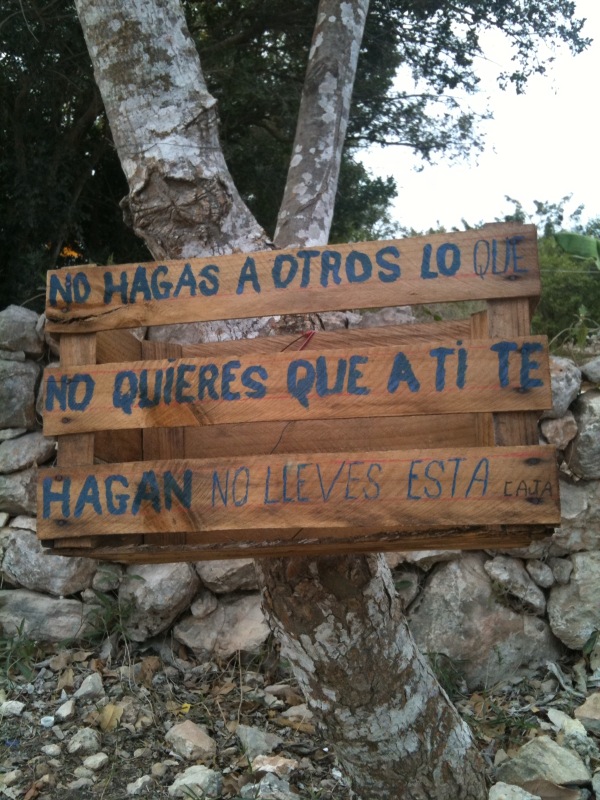
This is a photo of a box on a tree. Completely random and the uses for such an artifact unknown: is it a garbage box to keep the garbage away from street dogs while it awaits pickup by the garbageman? Is it a very large and insecure mail box awaiting a package from FedEx? And the carefully lettered sign is true and classic Mexican typography. Note the word ‘caja‘ didn’t quite fit so it was made a little smaller at the end, but perfectly lettered in its own way.

The text says:

“Don’t do unto others what you would not have them do to you. Don’t take this box”

Because you know you want to take that box, don’t you?

More on One of My Pet Peeves: El Tope

So (I have been listening to interviews on NPR and am surprised by the number of times people answering Terry Gross’ questions start with the word ‘so’) I live in this neighborhood – let’s call it La Ceiba, just for fun – that one could consider ‘upscale’  for Mérida; it’s on a golf course, the lots are large and there are a fair number of BMW’s and Audis driving around which seems to indicate a certain level of socioeconomic prosperity. What I am doing there sometimes baffles me, but we got in at a good time and I anxiously look forward to the day when golf will become appealing to me.

The roads within this fraccionamiento were all repaved with actual asphalt a few years back and the smooth surface seems to be irresistible to the frustrated Fitipaldis and Schumachers that inhabit the luxurious homes, and so, topes were introduced. First at occasionally conflicting intersections, then curves, then any straight stretch lasting for more than 500 meters.

Originally, yellow ‘boyas‘ also known as turtles in some quarters were used. These required a full stop and then gentle acceleration as you eased your vehicle over the obstacle; not doing so would result in severe damage to your cars’ suspension system. Interestingly, I observed that the drivers who would come to full stop were mostly men, while the women and offspring thumped over them with little concern. I attribute this to the fact that the men are paying the costs of their vehicle repairs, while the other drivers are oblivious to the damage they were causing.

After the stop and accelerate process became unbearable – do this eleven times on your way to and eleven times on your way from your home and you will slowly go insane – these nasty bumps were replaced by large concrete ramps that had an incline, a top and a decline, if that is the right word. Imagine a kind of wedge. These new topes are much easier to roll over; a high speed traverse will throw the whole car into an Evel Knievel fit, so they were also more effective at slowing down all drivers.

The tope project however, has meant an ongoing maintenance program in which thousands and thousands of pesos are spent sanding, smoothing and then painting these obstacles a bright yellow. I cannot think that there must be a more effective use of time and money than to spend it on these aberrations!

And yet, we can’t live without them, it seems. It’s a sad reflection of reality: Mexicans want the smooth streets they see on TV or have experienced on trips abroad, and yet, they can’t be bothered to drive responsibly on those same smooth roads, thereby requiring the almost medieval solution of physically placing barriers on those smooth roads to make them horribly bumpy again, thereby defeating the purpose of having a paved road in the first place. Because the undisciplined lot that we are cannot be trusted to obey a speed limit, even with the threat of injuring or killing a neighbors’ pet or child.